

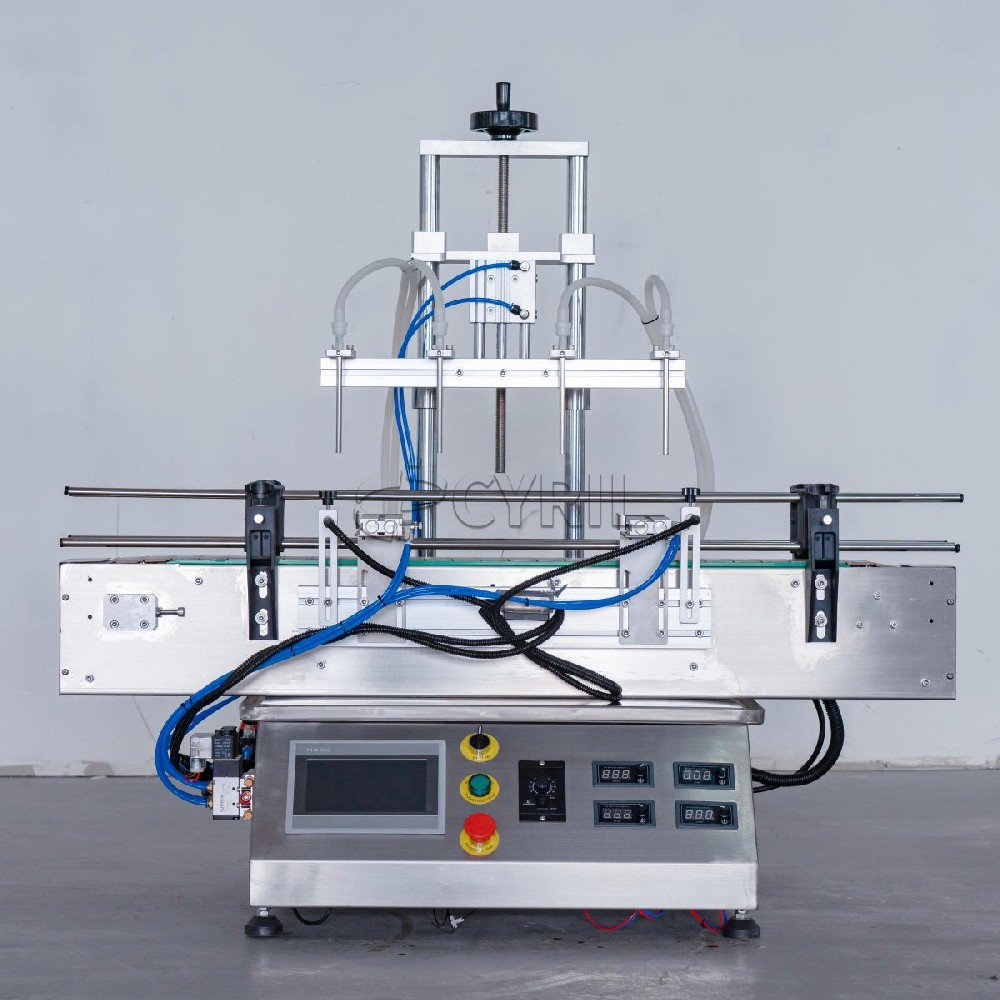
I. Basic Application
This machine is a dedicated desktop filling device, primarily designed for specific bottle types provided by the customer, suitable for continuous quantitative filling of such bottles. After operators become familiar with the equipment's performance and adjustment methods, it can be extended to filling applications in industries such as beverages, cosmetics, and pharmaceuticals, offering a certain degree of versatility and compatibility.
II. Technical Specifications
Number of Filling Heads: 4
Filling Accuracy: ±1%
Filling Speed: 600–1000 bottles/hour (based on 500ml filling volume)
Applicable Products: Various bottle types provided by the customer
Overall Dimensions: Approximately 1200×800×1300mm (L×W×H)
Power Supply: 220V 50/60Hz
Overall Weight: Approximately 200kg
III. Filling Process Step-by-Step Analysis
The equipment operation flow includes the following typical stages: manual bottle loading → conveyor transport → photoelectric detection → stop positioning → filling → release → output → collection. The specific sequence is as follows:
Loading Stage: Operators place empty bottles onto the conveyor infeed end in sequence, and the bottles move smoothly from left to right along the conveyor belt.
Detection and Positioning: When a bottle reaches the detection station, the photoelectric sensor identifies its presence and sends a signal to the PLC control system. The system then commands the conveyor motor to stop, holding the bottle at the filling position.
Filling Action: Upon detection of the bottle in position, the lifting cylinder lowers the filling valve assembly from standby to the filling position, while the bottle stop cylinder extends to secure the bottle in place. The filling valve opens to complete material dispensing according to the preset volume. After filling is completed, the bottle stop cylinder retracts to release the bottle, and the lifting cylinder returns the valve assembly to the standby position.
Release and Output: After a preset delay, the conveyor motor restarts to carry the filled bottles out of the filling area to the collection or subsequent processing stage.
Cycle Operation: The above actions repeat automatically, enabling continuous filling operation.