

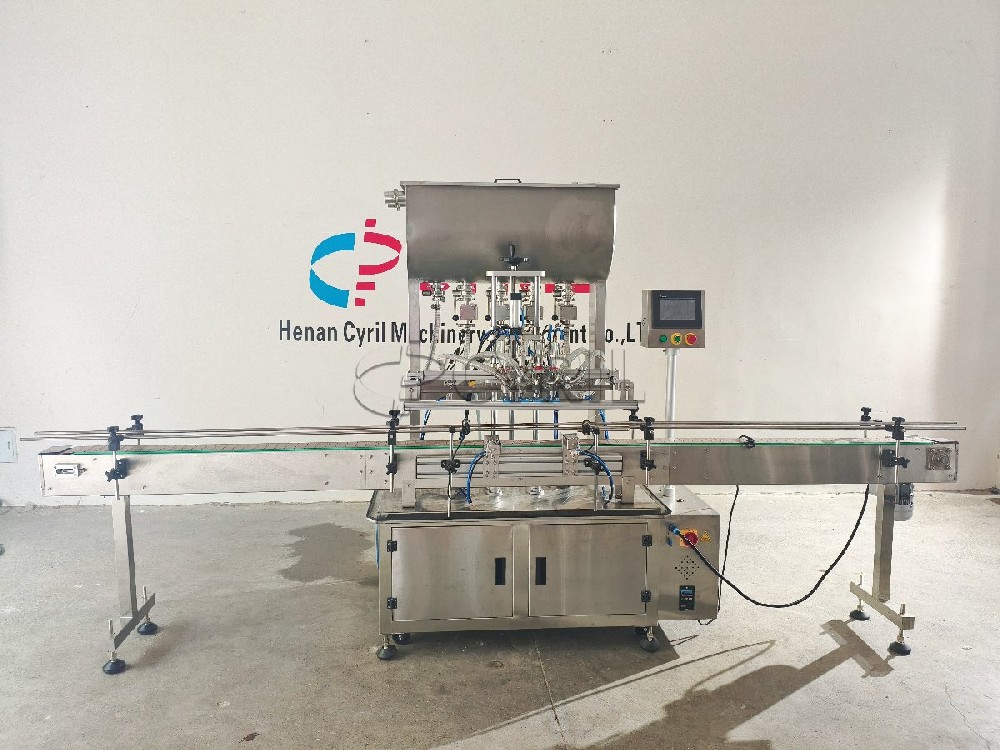
Common Faults and Troubleshooting for Fully Automatic Four-Head Liquid Filling Machine
During long-term operation, equipment may inevitably experience abnormal actions or delayed signal feedback. The following provides an analysis of two typical fault symptoms, along with corresponding troubleshooting approaches and handling measures for operator reference.
I. Cylinder Piston No Action
Fault symptom: The filling or stop cylinder fails to extend or retract after receiving a command, leaving the equipment in a stalled state.
Troubleshooting steps:
Check the emergency stop switch – Confirm whether the emergency stop button on the control panel has been accidentally pressed. If locked, rotate it clockwise to release and restore power and air supply.
Check the air supply – Confirm whether the main air supply valve is open and whether the supply pressure is within the equipment's required range (typically 0.4–0.6 MPa). Insufficient air pressure will prevent the cylinder from obtaining adequate driving force.
Check the solenoid valve – Verify whether the solenoid valve controlling the cylinder is powered properly, whether the valve spool is stuck, or whether the coil is burnt out. This can be determined using the manual test button or by replacing with a same-model valve. If damaged, the valve must be replaced promptly.
II. Cylinder Piston Cannot Retract After Extending
Fault symptom: The cylinder remains extended and cannot automatically retract, leaving the filling head or stop arm in the working position and affecting the next cycle.
Troubleshooting points:
Check the position and contact of the filling sensor – Confirm whether the proximity switch or magnetic sensor installed near the cylinder body maintains an effective sensing distance with the cylinder surface. If the sensor is displaced or loose, the PLC may not receive the piston-in-position signal, thus not issuing the retract command. Adjust the sensor position to ensure stable signal output when the piston reaches the end position.
Check the control program logic – If the sensor is functioning normally, verify whether the PLC output terminal is supplying power properly, or whether improper delay parameter settings are causing signal lag.
Handling recommendations:
During routine operations, if cylinder action anomalies occur, it is recommended to first verify air supply and signal status before attempting any disassembly. If the issue cannot be resolved after the above troubleshooting steps, contact the equipment manufacturer's technical personnel for further diagnosis. Do not forcibly pry or adjust mechanical stops, as this may cause component damage.