

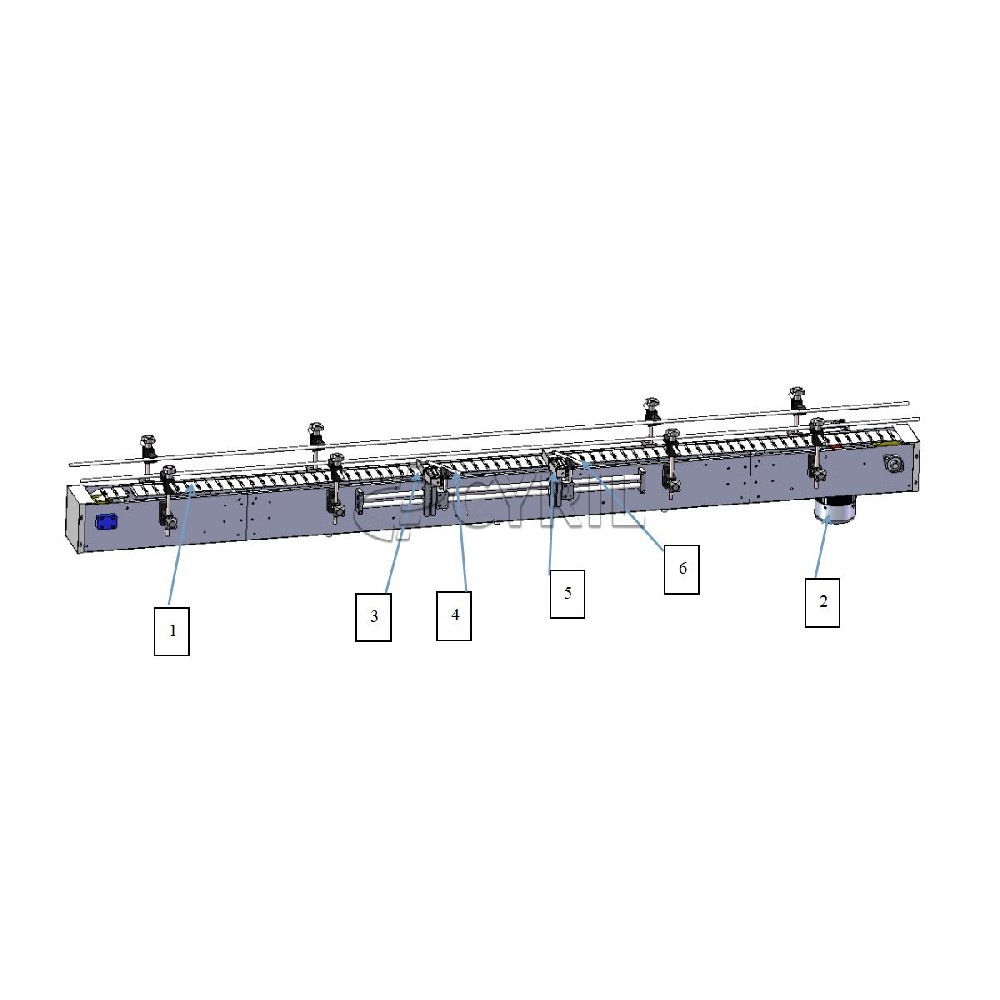
The conveying mechanism is the material flow foundation of the fully automatic four-head liquid filling machine, responsible for orderly feeding empty bottles into the filling area and smoothly discharging them after filling. Its operation relies on the coordinated cooperation of the chain conveyor, power system, detection components, and cylinder actuators. The following provides a functional description and action logic analysis for each key component of the conveying mechanism.
I. Plate Chain Conveying System
The plate chain is the core actuating component of the conveying mechanism. Through meshing with the drive gear, it converts the motor's rotary motion into linear translation, thereby moving bottles placed on the chain plate surface steadily forward in the set direction. The plate chain structure features strong load capacity, stable operation, and wide bottle type compatibility, making it suitable for long-term continuous operation.
II. Power Drive Unit
Conveying power is provided by a dedicated motor, whose output shaft connects to a reduction unit to adjust the speed to match the filling rhythm. Motor start/stop and speed regulation are automatically controlled by the PLC based on production line status, ensuring bottle supply pace coordinates with the filling action.
III. Infeed Stop Cylinder
The infeed stop cylinder is installed at the front section of the conveying mechanism. Its function is to control the entry of subsequent bottles based on the number of bottles at the filling station. When the filling station reaches capacity, the cylinder piston extends to block further bottles from advancing, preventing accumulation or squeezing. After the filling station is vacated, the cylinder retracts to release the next batch of bottles.
IV. Infeed Counting Sensor
This sensor is a diffuse reflection photoelectric device installed at the entrance of the filling station. It is used to count in real time the number of bottles entering the filling area. When the count reaches the preset value (typically corresponding to the number of filling heads, e.g., four), the sensor sends a signal to the PLC, which then commands the infeed cylinder to actuate and complete the batch blocking action.
V. Outfeed Stop Cylinder
The outfeed stop cylinder is installed at the exit end of the filling station. Its main function is to block bottles that have been filled but not yet released, keeping bottles currently being filled stable at the filling position and preventing movement caused by continuous conveyor operation. After the filling action is completed, the cylinder retracts according to the preset timing to release the filled bottles.
VI. Outfeed Counting Sensor
The outfeed counting sensor is installed at the exit of the filling station and is used to count the number of filled bottles that have been released. When the count reaches the set number, the sensor sends a signal to the PLC, which then controls the outfeed cylinder action and subsequent infeed flow according to program logic, achieving automatic cyclical control of the entire conveying process.