

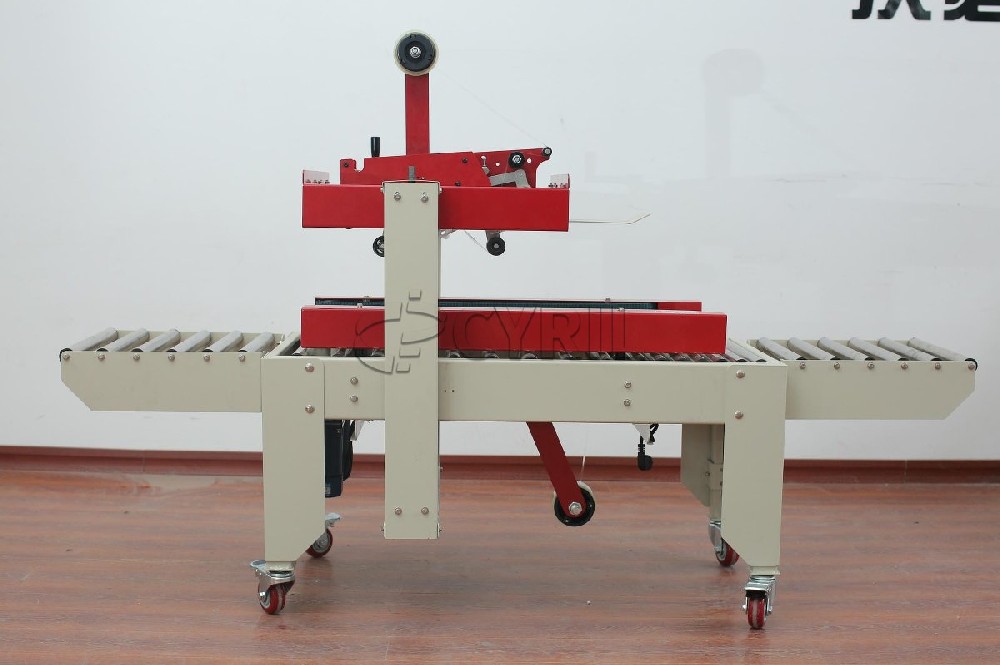
Carton Sealing Machine Operation Guide and Selection Points
The carton sealing machine is a commonly used device for fast carton sealing. Its operation is relatively straightforward, but correct usage and proper selection directly affect packaging efficiency and equipment lifespan. The following provides a systematic overview from four aspects: working principle, operating steps, selection criteria, and safety precautions.
I. Working Principle
After power connection and startup, the operator places the folded carton onto the conveying track. When the carton reaches the left and right conveyor belts, the power units drive it forward. Upon passing through the sealing head, the adhesive tape is automatically applied to both the top and bottom of the carton. The cutting mechanism completes the severing action, and the rear pressing device smooths and secures the tape, completing the entire sealing process.
II. Standard Operating Procedure
Adjust the chassis height and the left and right width adjustment handwheels to match the carton dimensions.
Connect the power cord and press the rocker switch; the indicator light confirms the machine is powered and ready.
Fold the carton flaps, place the carton steadily onto the conveying platform, and the left and right conveyor belts automatically push it forward.
The machine automatically applies, cuts, and presses the tape, with the sealed carton exiting from the output end.
III. Key Factors to Consider When Selecting a Carton Sealing Machine
Carton Size and Weight: Different models have varying load capacities. Heavy-duty cartons require machines with matching load ratings, while standard models are suitable for ordinary cartons. Some materials may cause carton expansion after filling, which should be assessed in advance or accommodated with custom solutions.
Sealing Direction: Machines are categorized by sealing orientation: top-bottom sealers and side sealers. The former are suitable for standard carton packaging, such as food bags in cartons or pharmaceutical outer boxes; side sealers are appropriate for horizontal packaging, such as beverage cartons.
Adjustment Method: For fixed product specifications with infrequent changes, manually adjustable models are suitable. For frequent size changes, models with automatic adaptation are recommended to reduce downtime.
Installation Space: Available installation space and operational clearance should be confirmed in advance to avoid placement issues or workflow obstruction after delivery.
Usage Scenario: Semi-automatic models are suitable for standalone use, while automatic or random-type models are recommended for integration into production lines.
IV. Operation and Safety Precautions
Keep the working area dry. Do not wash the equipment with water, and operators should not work barefoot.
Keep hands clear of the left and right conveyor belts and transmission components during operation.
Regularly lubricate key moving parts to ensure smooth operation.
Do not arbitrarily replace or modify mechanical structures or electrical components, as this may affect safety and stability.
In case of abnormality, press the emergency stop button to cut power before handling. Do not operate the machine with existing faults.