

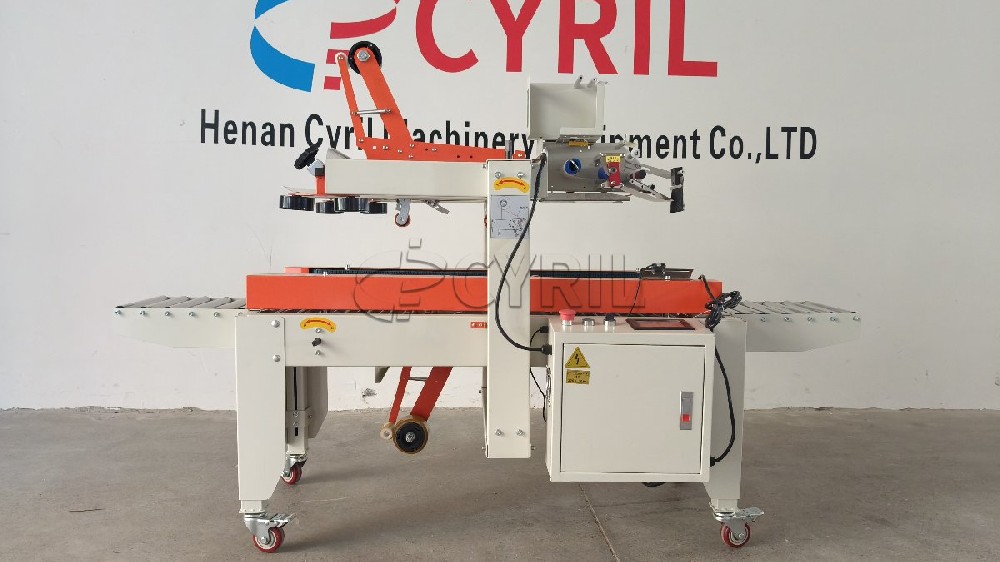
Comprehensive Guide to Carton Sealing Machines: Types, Features, and Working Principles
A carton sealing machine is a packaging device that uses adhesive tape to seal cartons. It is widely used across industries such as food, beverages, pharmaceuticals, daily chemicals, hardware, and electronics. It can operate as a standalone unit or be integrated with other equipment like case openers, labelers, coders, and shrink wrappers to form a complete packaging line.
I. Common Types and Applicable Scenarios
Based on automation level and adjustment methods, carton sealing machines are mainly divided into four types:
Uniform Semi-Automatic: Requires manual pushing of cartons. Suitable for products with similar dimensions and high-volume batches.
Uniform Automatic: Automatically conveys cartons without manual pushing, but requires manual adjustment for size changes. Suitable for continuous production of single-specification cartons.
Random Semi-Automatic: Automatically adapts to cartons of different sizes without manual adjustment. Operators only need to place the cartons for sealing.
Random Fully Automatic: Requires no manual intervention throughout the process, continuously handles cartons of various sizes, suitable for mixed-flow production lines.
II. Main Structural Components
A carton sealing machine typically consists of the following parts:
Conveying Platform: Equipped with closely arranged rollers to support and transport cartons.
Left and Right Conveyor Belts: Drive cartons forward smoothly. Dual-motor designs provide extra power for heavier cartons.
Height and Width Adjustment Mechanisms: Allow quick size changes via handles to accommodate different carton dimensions.
Sealing Head Assembly: Integrates tape cutting and pressing mechanisms to complete top and bottom sealing in one pass.
Auxiliary Structures: Include flattening top plates, support frames, power switches, emergency stop buttons, and casters at the base for convenience and safety.
III. Core Functional Features
The machine incorporates advanced sealing pad structures that flatten raised carton flaps, ensuring smooth and firm tape adhesion. The top and bottom belts are independently driven to handle wide, heavy cartons. The vertically designed sealing head allows easy tape replacement. Both rollers and belts are made of thickened wear-resistant materials for enhanced load capacity and smooth operation. The compact structure and flexible adjustability cover a wide range of carton sizes, particularly suitable for efficient sealing of small boxes.
IV. Working Principle
During operation, cartons enter the sealing area via the conveying platform, and the left and right conveyor belts move them forward. Simultaneously, the top and bottom sealing heads apply, press, and cut the tape in one synchronized action, completing double-sided sealing in a single pass. For different carton sizes, the adjustment mechanisms enable quick adaptation without complex tools, making the machine ideal for high-volume continuous production.