

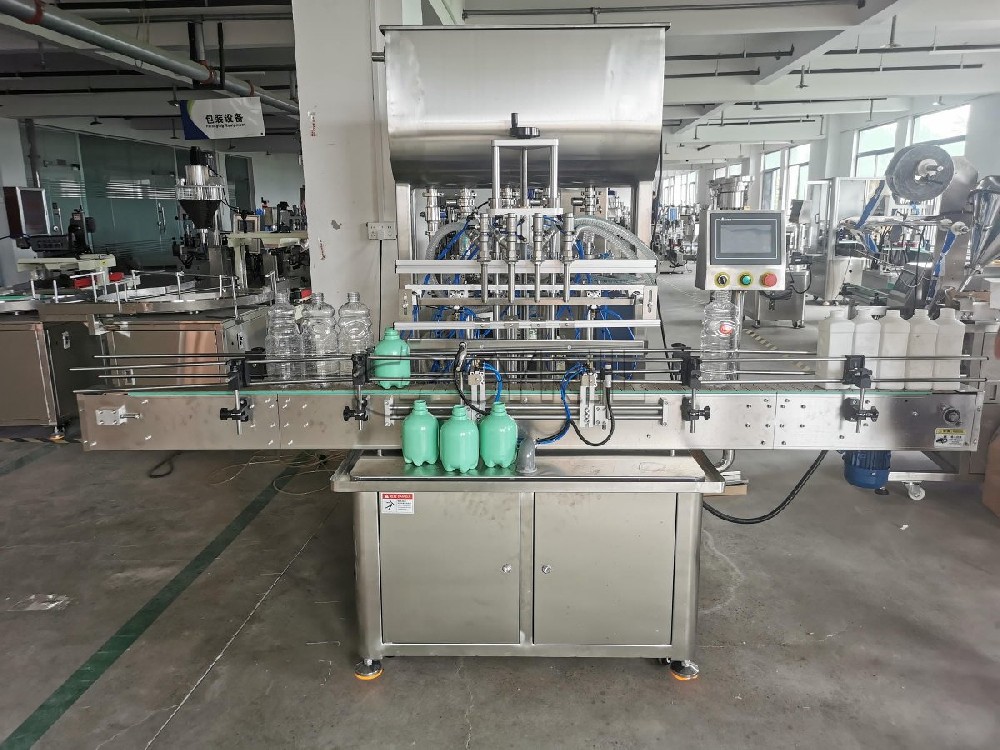
Working Principle
The GZJ-4G series fully automatic piston-type paste filling machine is driven by pneumatic power, with the cylinder's reciprocating motion driving the piston inside the material cylinder in synchronization. When the piston moves backward, a negative pressure is created in the front chamber of the material cylinder, drawing material inward. When the piston moves forward, the material is pushed out and dispensed into containers through the filling valve. The filling volume is adjusted by controlling the cylinder stroke via the signal valve—the longer the stroke, the greater the volume of material drawn and dispensed each cycle. This metering method features a simple structure and intuitive adjustment, reliably ensuring filling accuracy.
II. Equipment Application Fields and Configuration Features
This model is suitable for quantitative filling of products with varying viscosities, including liquids and creams, and is widely used in industries such as daily chemicals, food, pharmaceuticals, and oils and fats. The equipment features a compact layout with a streamlined appearance and reasonable structure, facilitating easy installation and integration into production lines. Key pneumatic components are sourced from well-known brands including Germany's SIKE, Shanghai Airtac, and Taiwan's Chumg, ensuring good stability and durability from air source treatment to actuation, maintaining reliable performance during continuous operation.
The equipment offers the following functional features:
Convenient Adjustment: Filling volume is controlled by the signal valve regulating cylinder stroke. Adjustment is simple and requires no special tools.
No-Bottle No-Fill: Equipped with photoelectric detection that triggers the filling action only when a container is detected in position, preventing material waste.
Accurate Metering: The piston-type structure is minimally affected by material viscosity, offering high repeatability.
Counting Function: An integrated counting module facilitates production data statistics.
III. Key Factors Affecting Equipment Performance
In actual operation, the following factors directly affect filling accuracy and speed:
Filling Accuracy: Affected by air pressure stability, material uniformity, and filling speed. Fluctuations in air pressure or the presence of bubbles, agglomerates, or other inconsistent components in the material may lead to metering deviations.
Filling Speed: Constrained by multiple factors including material viscosity, preset filling volume, nozzle inner diameter, and conveyor belt speed. Higher viscosity or larger filling volumes may require appropriately reduced filling speed to maintain accuracy.