

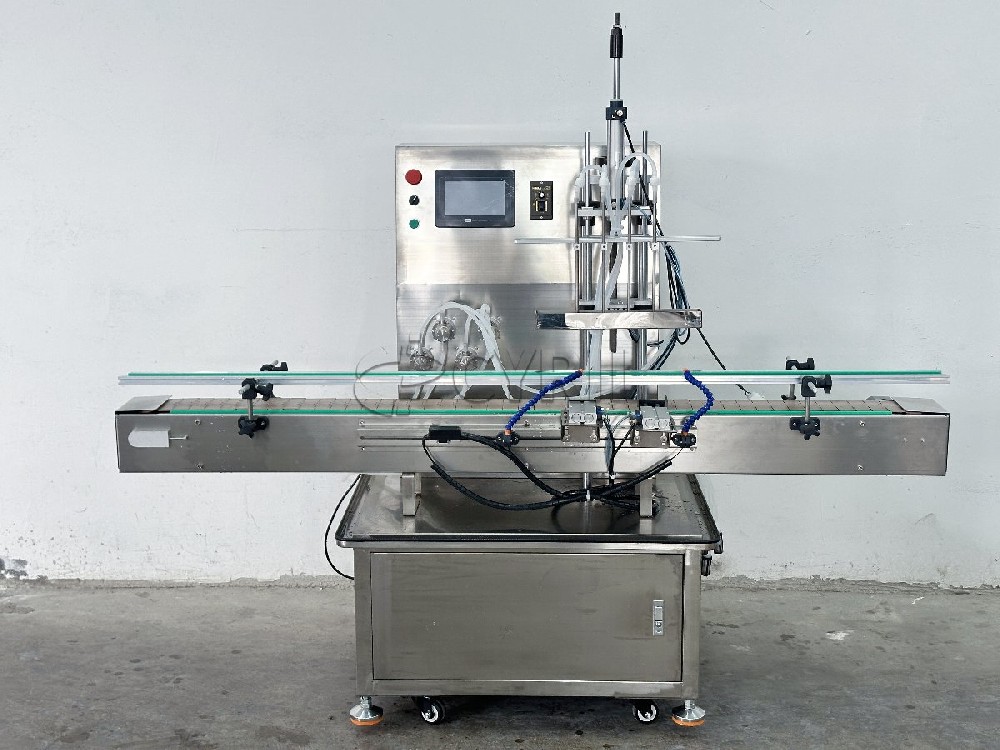
I. Factors Affecting Filling Accuracy and Adjustment Methods
Filling errors mainly originate from the preset filling volume, filling speed, and the response speed of the upper and lower valves. Among these, the valve switching speed is closely related to the viscosity of the material: the higher the viscosity, the greater the resistance to valve movement, resulting in slower response and affecting the accuracy of the filling end point.
An effective way to adjust valve switching speed is to regulate the valve spring pressure. Increasing the spring pressure accelerates valve closing and resetting, making it suitable for low-viscosity materials. Reducing spring pressure slows down the closing speed, which helps reduce stringing or dripping of high-viscosity materials at the moment of cut-off. The specific spring pressure setting should be fine-tuned based on trial filling results and the operator's on-site experience, achieving a balance between accuracy and efficiency.
II. Safety Operation Precautions
To ensure operator safety and stable equipment operation, the following safety guidelines must be observed when using this machine:
Overflow Handling: If material overflow or dripping occurs at the filling nozzle (see Figure 1, Item 06), immediately press the emergency stop switch to cut off equipment operation. Clean up the spill before resuming operation to keep the work area tidy.
Cleaning Protection: When disassembling for cleaning, do not directly rinse the machine body with water, as this may allow water to enter electrical components or pneumatic systems, causing short circuits or corrosion. It is recommended to use a soft cloth dampened with cleaning agent for wiping.
Pneumatic System Protection: Pneumatic connections and tubing must not be arbitrarily disconnected or modified, as this may cause air leaks, pressure instability, or abnormal cylinder operation.
Abnormal Reset Operation: If the cylinder fails to retract after extending due to improper operation, press the reset button on the panel to restore the equipment to its initial state. Do not forcibly strike or pry the cylinder, as this may cause mechanical damage.
The above content is recommended as part of routine operator training to help personnel correctly understand the logic of accuracy adjustment and master essential safety practices.