

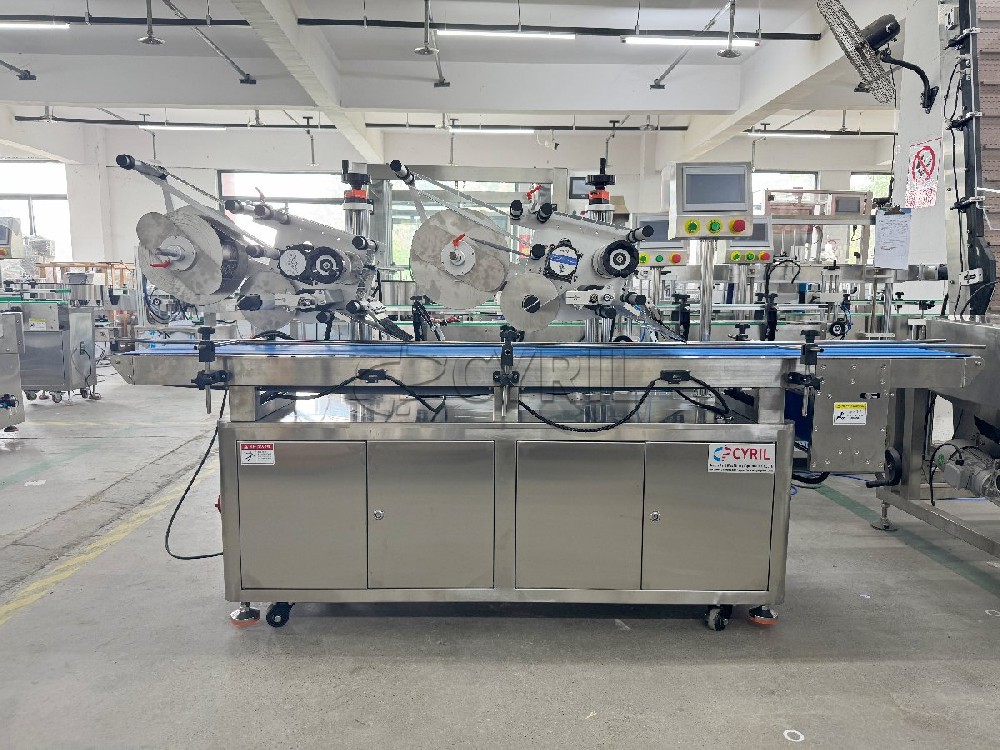
Labeling Equipment Selection Guide: Type Analysis and Adaptation Points
Labeling machines apply pressure-sensitive labels to product surfaces automatically by peeling labels from the backing paper, transferring them, and applying pressure. Different application scenarios impose varying requirements on equipment functionality, structure, and operation modes. Understanding the basic working principles and classifications is the first step in making a scientifically informed selection.
I. Basic Workflow of Labeling Machines
Label rolls pass through guide rollers to the peeling blade, where the face material separates from the backing paper. The label is then transferred to the product surface and pressed firmly by a pressure roller or wiping device to ensure smooth and secure adhesion. The entire process involves multiple variables, including tension control, positioning accuracy, and pressure adjustment. Therefore, equipment selection must consider both machine performance and product characteristics.
II. Classification by Automation Level
Based on operation mode, labeling equipment can be divided into the following three categories:
Fully Automatic Labeling Machines: Integrated directly into existing production lines without manual intervention, suitable for continuous high-volume production. They support various configurations, including front-and-back labeling, wraparound labeling, top-and-bottom labeling, or combined labeling processes.
Semi-Automatic Labeling Machines: Require operators to manually place products into dedicated fixtures or mandrels and trigger labeling via a foot pedal. These machines are generally benchtop designs, easy to move and switch over, making them suitable for small-batch or multi-variety production scenarios.
Standalone Labeling Machines: Feature independent frames and control systems, capable of operating alone or flexibly integrated into customers' existing conveying systems, offering both automation efficiency and layout flexibility.
III. Key Factors to Evaluate When Selecting a Labeling Machine
In addition to common considerations such as production capacity and budget, the following technical adaptation points should be emphasized:
Product Surface Characteristics: The shape of the labeled object directly affects label adhesion and smoothness. Confirm whether the equipment supports labeling on flat, convex, concave, or irregular surfaces, and assess whether the wiping structure adequately conforms to the product.
Label Positioning Requirements: Different products have varying specifications for label placement. The equipment should have precise positioning control capabilities to consistently achieve top, bottom, front, back, or combined placement.
Product and Label Dimensions: The equipment must accommodate the product size range and label width variations, ensuring that the label feeding and application components can handle the actual specifications.
In summary, equipment selection should be based on a clear understanding of product form, label type, and production line characteristics, with a comprehensive evaluation of machine type and functional configuration to achieve a balanced outcome in efficiency, precision, and cost.