

How to Choose Peanut Butter Filling Equipment? Two Key Indicators Determine Quality
Among sauce products, peanut butter is particularly challenging to fill due to its high oil content, suspended particles, and high viscosity, which often lead to unstable equipment performance. Many manufacturers, without fully considering the material's characteristics, frequently encounter issues such as poor discharge, dripping, and metering deviations after commissioning, severely affecting production efficiency. When selecting filling equipment for peanut butter, the focus should be on two core indicators: "viscosity compatibility" and "drip-proof design."
I. Viscosity Compatibility – Ensuring Smooth Discharge and Stable Metering
Peanut butter is highly viscous and contains particles, requiring equipment with strong material adaptability. First, the storage hopper should be equipped with an active stirring device to continuously agitate the sauce, preventing oil separation and solid sedimentation to maintain uniform consistency. Second, the internal piping and filling valves should feature a large-bore, dead-angle-free design to allow smooth passage of the particle-laden sauce without crushing granules or causing blockages. Third, a servo-driven piston-type metering system is recommended. This mechanism uses mechanical piston propulsion for precise and controllable dosing, offering better repeat accuracy for high-viscosity materials compared to gravity-flow or pneumatic systems.
II. Drip-Proof Design – Eliminating Stringing and Improving Yield
During peanut butter filling, stringing and residue adhesion are common at the cut-off point, which can contaminate bottle mouths and surfaces, even affecting sealing quality. A reliable machine should be equipped with a vacuum return device at the filling nozzle, which actively retracts residual material at the end of each cycle, effectively cutting the sauce string and keeping containers clean, thereby reducing downstream cleaning costs and rejection rates. In contrast, basic models without such mechanisms tend to produce significantly higher waste rates in long production runs, making them unsuitable for large-scale manufacturing.
III. Versatility and Sanitary Compliance
Beyond core functions, the equipment should support multi-specification adaptability, allowing quick filling volume changes via touchscreen to accommodate various bottle types, including wide-mouth jars and irregular containers. All material-contact surfaces must be made of 304 stainless steel, easy to disassemble and clean, and fully compliant with food safety standards.
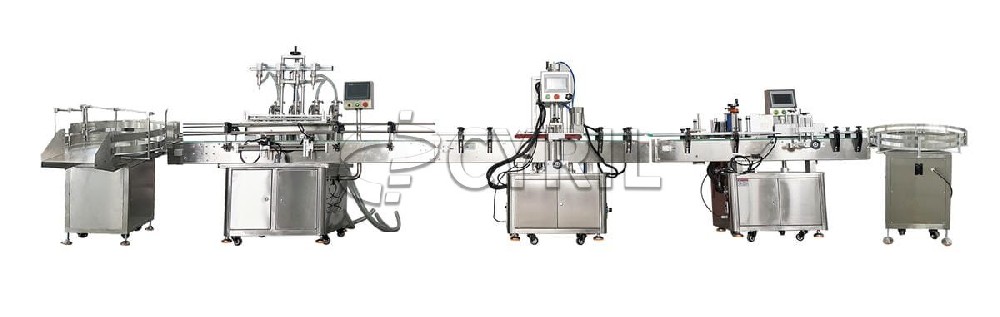
With years of practical experience in sauce filling, we have developed dedicated systems tailored to the properties of peanut butter, featuring enhanced stirring, anti-clogging, and vacuum return structures. These systems can be integrated with capping and labeling equipment to form a complete production line, meeting the practical needs of peanut butter processing facilities.