

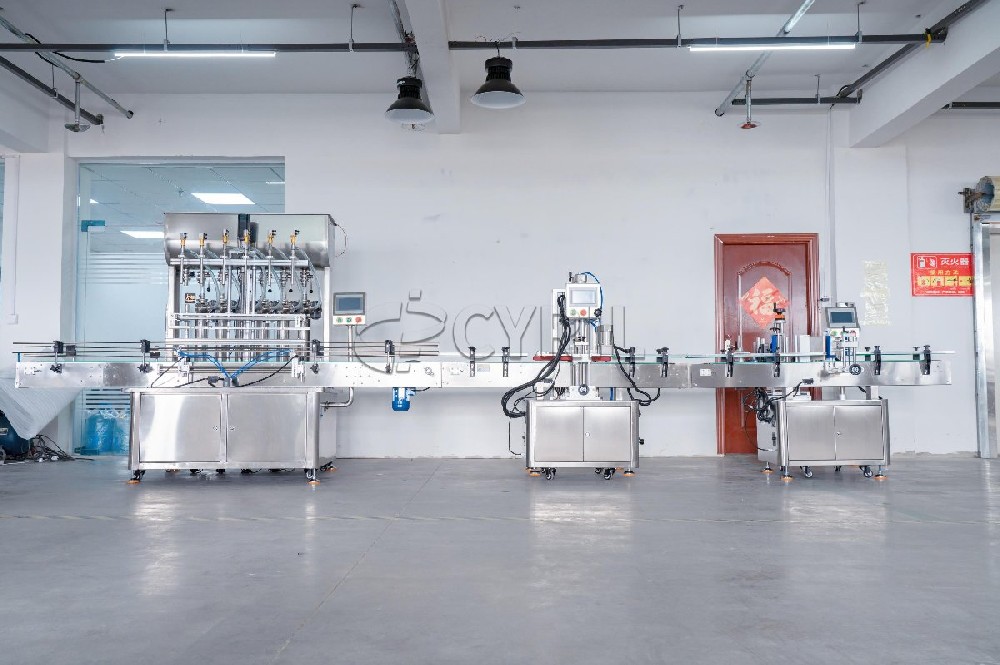
In the chemical industry, filling-capping-labeling machines are continuously driving innovation, improving production efficiency and product quality. These machines integrate three major processes—liquid filling, cap tightening, and label application—into one fully automated system, making them a key piece of equipment for production upgrades in the chemical sector.
I. What is a Filling-Capping-Labeling Machine?
This equipment combines filling, capping, and labeling functions into a single unit, automatically completing liquid metering and filling, cap tightening, and precise label application. Compared to traditional manual operations, it significantly improves production efficiency and product consistency.
II. Application Scenarios in the Chemical Industry
The chemical industry produces a wide variety of products, from detergents and cosmetics to industrial chemicals, all of which require filling, capping, and labeling. Traditional manual operations are time-consuming and error-prone. Filling-capping-labeling machines are particularly suitable for high-precision filling needs, such as viscous liquids like detergents, effectively ensuring production quality.
III. Introduction of Innovative Technologies
Modern equipment incorporates PLC control systems and sensor technology, enabling intelligent monitoring and real-time parameter adjustments. This gives the equipment greater adaptive capabilities, ensuring stable and precise production processes.
IV. Reducing Labor Costs
A single machine can replace multiple workers in filling, capping, and labeling tasks, significantly reducing labor costs while allowing employees to focus on more creative roles.
V. Improving Product Quality
Precise mechanical operation eliminates human errors, ensuring that every product meets quality standards while reducing production losses. This provides a quality assurance advantage in a highly competitive market.
VI. Environmental Protection and Sustainable Development
The equipment reduces material waste and improves resource utilization, aligning with green production and sustainable development concepts, helping the chemical industry transition toward more environmentally friendly practices.
VII. Future Development Trends
In the future, with advances in IoT and intelligent technologies, filling-capping-labeling machines will achieve more efficient data exchange and automatic parameter adjustments, moving toward truly "intelligent production."
Conclusion
The application of filling-capping-labeling machines in the chemical industry has significantly improved efficiency, quality, and environmental performance, with broad prospects for the future as they continue to drive industry upgrades.